
Case study
Toronto Grocery Delivery Market Research
Before designing the product, I needed to answer a bigger question: should this product exist, who should it serve, and how could it stand out?
This was a research-first project: Because sometimes the most valuable UX work is not designing the app. It is preventing the team from building the wrong one.
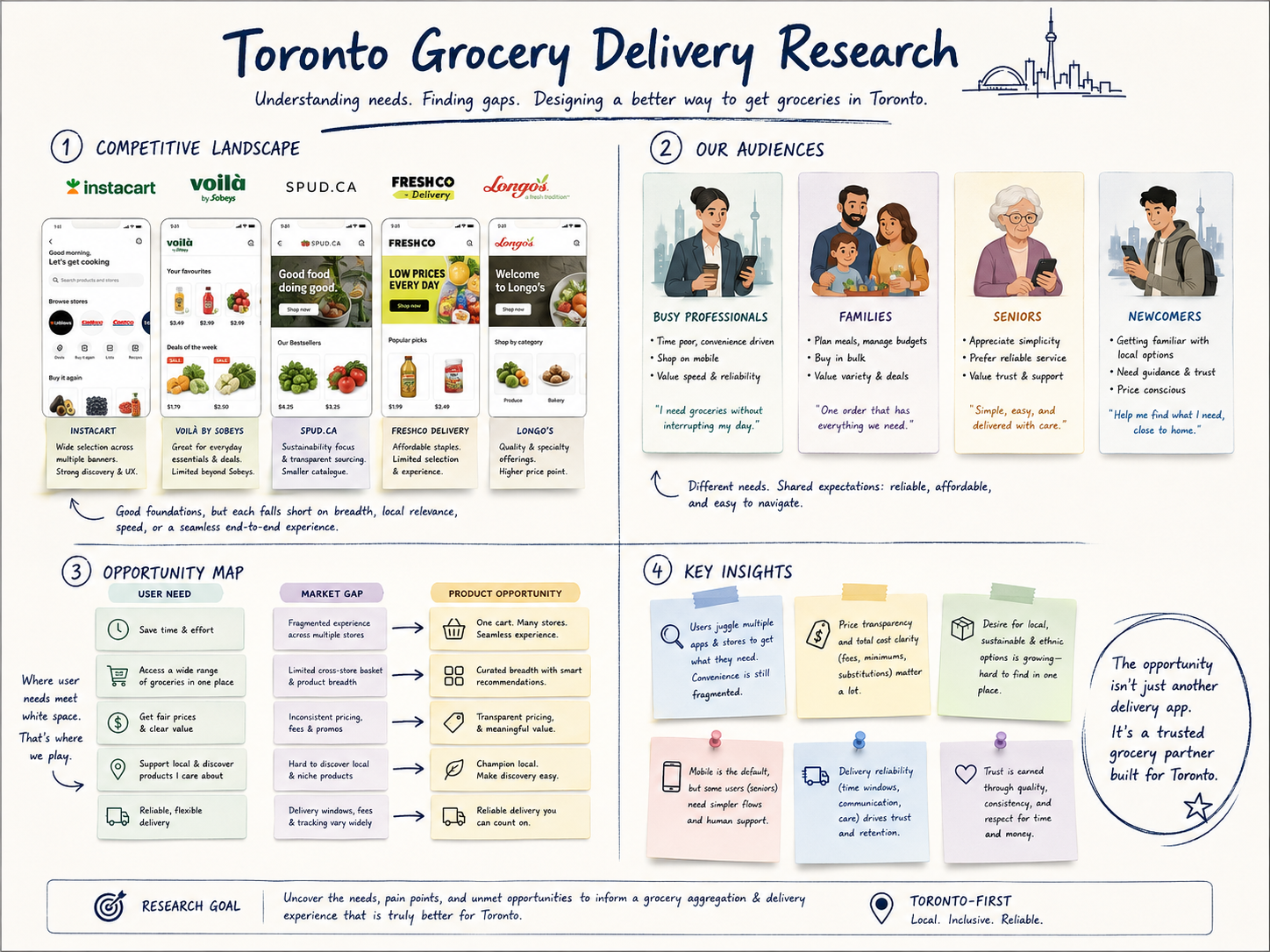
The problem
The grocery delivery space in Toronto is crowded.
Users already have access to major grocery chains, delivery apps, local stores, and marketplace services.
The research needed to clarify:
- Who should the product serve first?
- What do competitors already do well?
- Where do users still feel underserved?
- What position could make the product distinct?
- Which opportunities could guide early launch decisions?
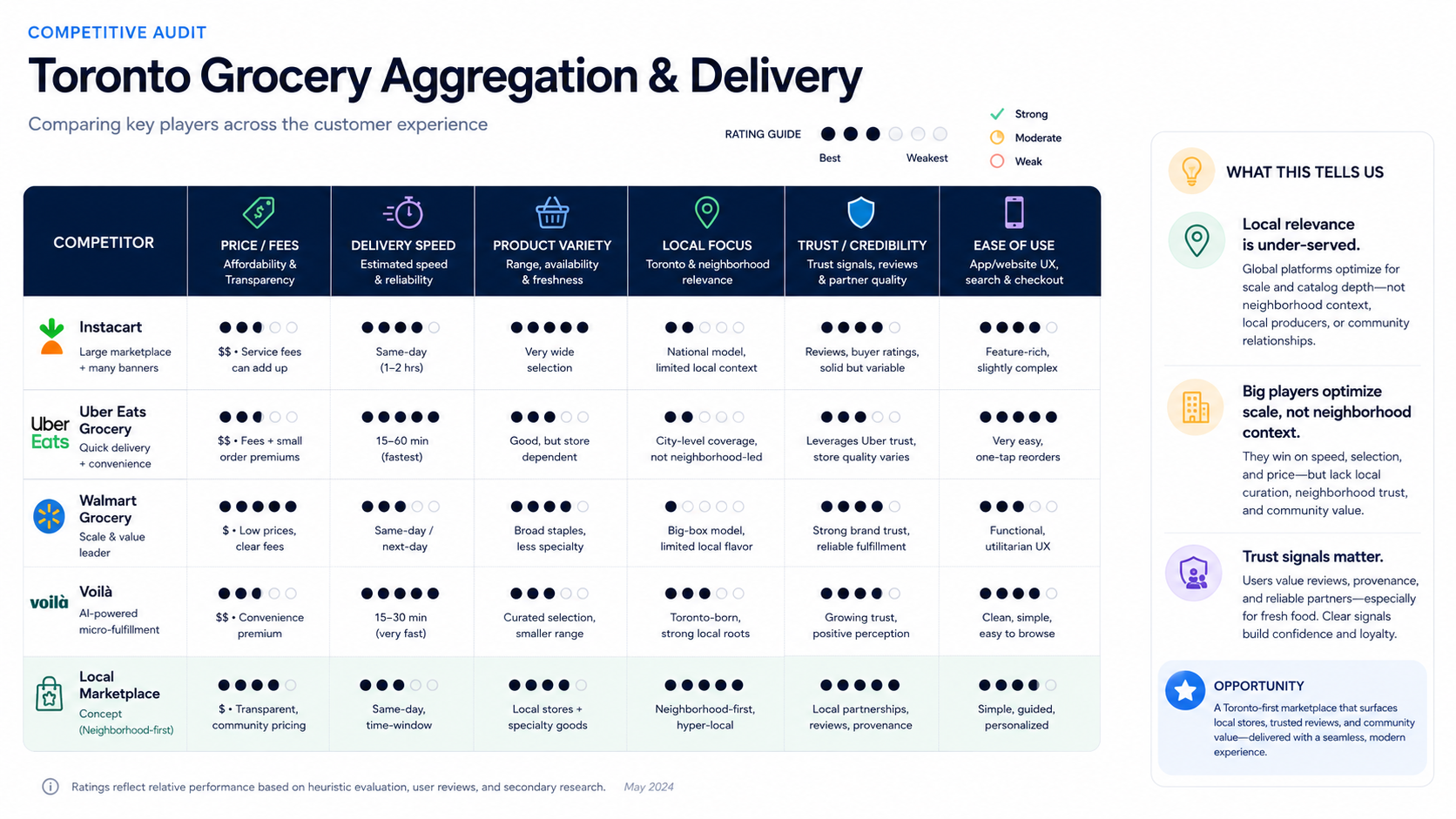
Competitive audit
A new grocery product could not win by saying, "we deliver groceries too".
Reviewed grocery delivery platforms, food delivery services, marketplace models, and local grocery options, comparing them across value proposition, target audience, delivery model, convenience, local relevance, trust signals, pricing signals, product experience, strengths and weaknesses.
- What are the dominant grocery delivery options in Toronto?
- What user needs are already well-served?
- What pain points or gaps still exist?
- Which audience segment has the clearest need?
- What product position could create meaningful differentiation?
Key insight 1
Convenience alone is not enough.
Most competitors already compete on convenience, speed, and access.
That meant a new product needed a sharper reason to exist. “Fast delivery” was not a strong enough differentiator on its own.
The opportunity was to identify a more specific audience and a more focused promise.
Key insight 2
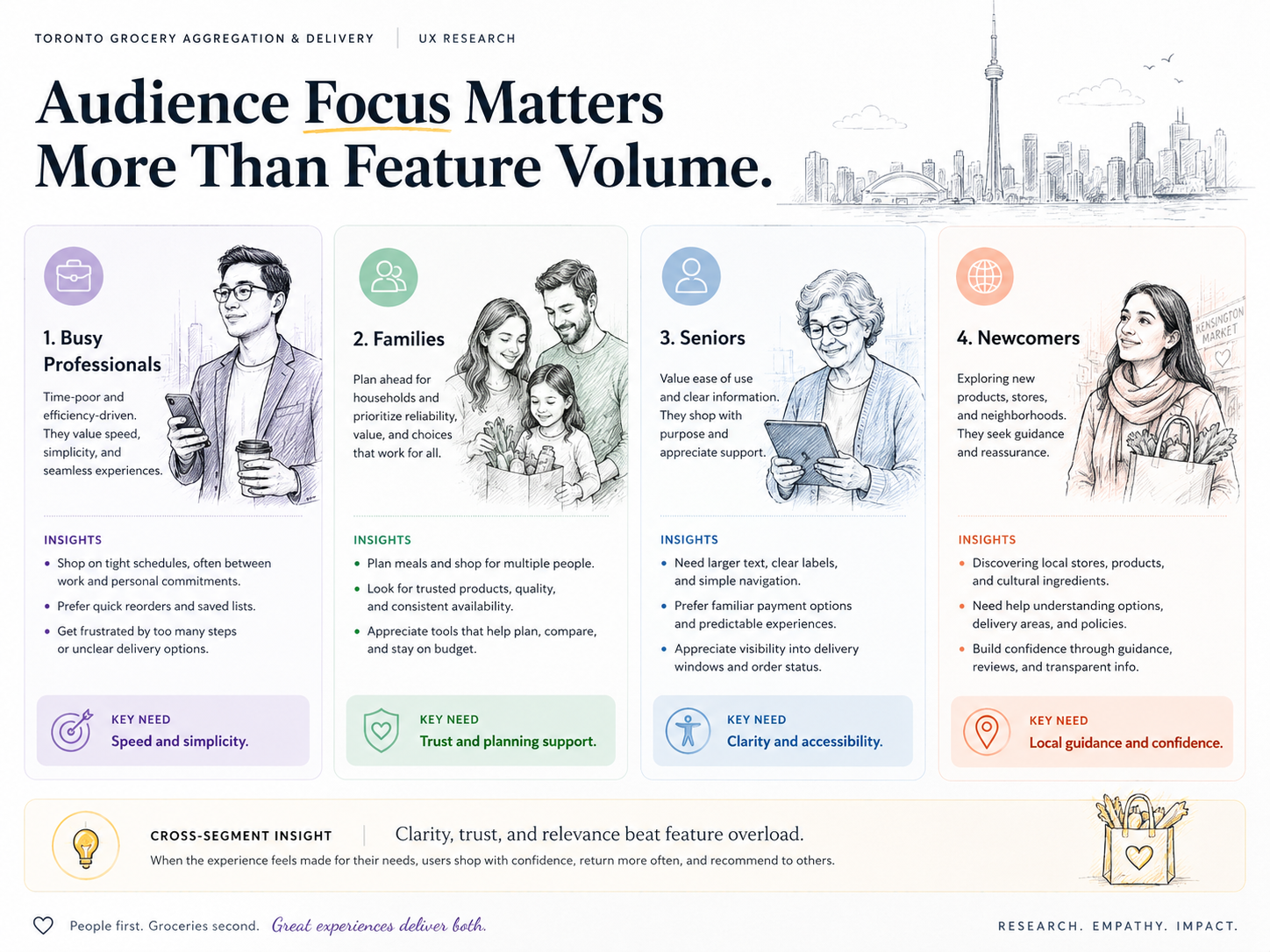
Audience focus matters more than feature volume.
A broad 'everyone buys groceries' audience was too vague.
Different groups have different needs: busy professionals, families, seniors, newcomers, culturally specific shoppers, mobility-limited users, and local-market shoppers.
The product needed a priority audience before defining MVP features.
Key insight 3
Trust is a major part of grocery delivery.
Grocery delivery is not just logistics. Users care about food quality, substitutions, freshness, reliability, and whether the shopper understands what they actually want.
This created an opportunity to think beyond delivery speed and focus on trust, clarity, and local relevance.
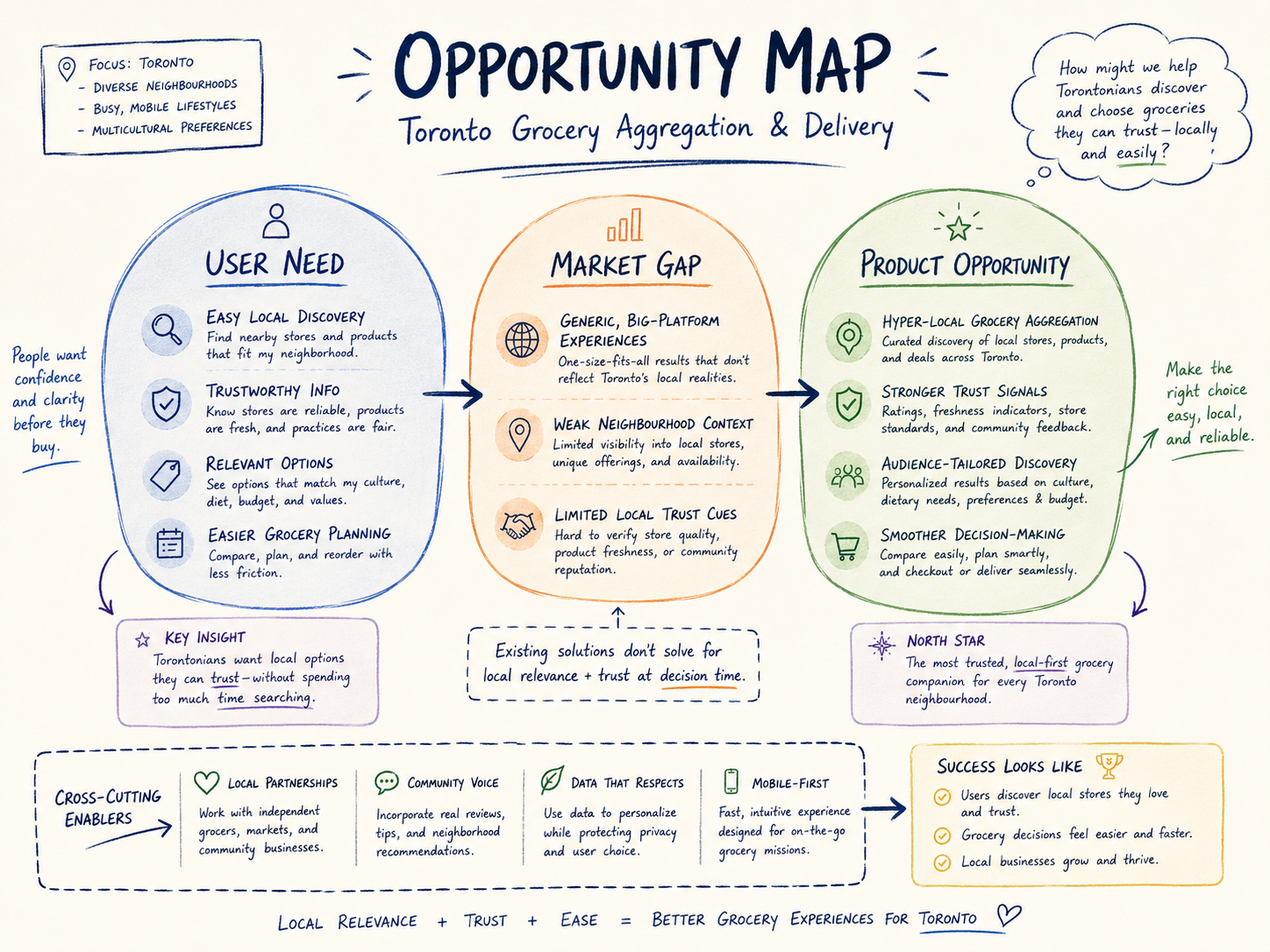
Opportunity areas
Where User Needs Meet Market Gaps.
- Clearer audience targeting
- Local grocery access
- Better substitution communication
- Trust-building product cues
- More transparent delivery expectations
- Product positioning beyond generic convenience
The product should launch with a clearer audience, sharper positioning, and a focused MVP promise.
Impact
What the Research Made Clear.
The research turned a broad grocery delivery idea into a clearer product direction by defining the right audience, market gaps, positioning opportunities, launch focus, and MVP priorities.
- Audience focus
- Competitive gaps
- Product positioning
- Early launch direction
- MVP decision-making
Reflection
UX research as a business strategy.
This project shows my ability to use research before design to reduce product risk and improve strategic clarity.
No shiny prototype needed. Just evidence, synthesis, and the quiet joy of making a complicated product idea make sense.